
What Does It Cost Me to Be and Feel Like a Woman?
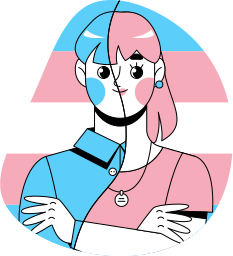
What does it really cost to become — and feel — like yourself? For many trans women, beauty isn’t just about makeup or clothes; it’s about recognition, belonging, and survival. In this deeply personal reflection, one woman shares what it truly means to step into her identity — from the financial costs of hormones, therapy, and self-care, to the emotional price of seeking acceptance in a world that often looks away.
It’s a story by Loreta Divine - a brave tale about resilience, self-love, and redefining beauty — not as perfection, but as honesty. Because sometimes, the most powerful transformation isn’t in how the world sees you, but in finally seeing yourself.
What Does It Cost Me to Be and Feel Like a Woman?
by Loreta Divine
For most of my life, I thought beauty was something that belonged to other people — the kind of effortless grace I could only watch from the outside. I used to stare at women in cafés, at the way their hair caught the light or how they touched their necklaces while laughing, and I’d feel something aching inside me. It wasn’t envy. It was recognition — like seeing a language I was born to speak but never learned.
Becoming a woman wasn’t a decision I made one day.
It was a truth that had been whispering in me for as long as I can remember, something I tried to silence because the world didn’t want to hear it. You can’t fight something that deep without breaking yourself. So, one day, I stopped fighting.
And that’s when the real costs began…
Not just the financial ones — though those come fast and heavy. Hormone therapy: about $80 a month. Blood tests and doctor visits: another $200. Laser hair removal — $1,000 just to start, and that’s before you even think about the body treatments. A good wig, until your own hair catches up — $400. A single makeup session to learn how to contour for your face shape — $150.
But money is the easiest price to count.
The harder cost is asking the world to understand. The way people tilt their heads when you tell them your name. The friends who stop calling. The strangers who think your body is an invitation for questions. You start to realize that every ounce of self-acceptance has to be earned twice — once from yourself, and once from everyone else.
Still, when I look in the mirror now, I see softness where there was once tension. I see a woman who has paid more than she ever imagined, but finally lives in a body that feels like home. And that — more than any surgery or serum — is the most beautiful thing I’ve ever owned.
Beauty, I’ve learned, isn’t a finish line — it’s a daily negotiation. Every morning I face the mirror like it’s a conversation: Is this the woman I want to show today? Is she strong enough to walk outside? Some days it’s lipstick and confidence. Other days it’s just foundation and a shaky smile. There’s pressure in knowing that being “beautiful” feels like part of being believed — that if I don’t look feminine enough, some people might stop seeing me as real.
So I spend more.
More on skincare, more on clothes that make my shoulders look smaller, more on shoes that make me feel graceful instead of awkward. It adds up — not only on my credit card, but on my spirit. Every purchase feels like a tiny prayer: Please, let them see me as I see myself.
Therapy costs, too — about $100 a week — but it’s the only place where beauty doesn’t have to perform. It’s where I can talk about the days I feel invisible, or the nights when I wonder if all this effort will ever feel natural. My therapist says transition isn’t a race; it’s an unfolding. But unfolding can be painful when the world keeps asking you to hurry up and “be done.”
And yet, there are moments that make it all worth it.
When a child calls me “ma’am” without hesitation. When I catch my reflection in a window and, just for a second, forget that I was ever anyone else. When I feel beautiful not because I tried, but because I am.
Maybe beauty was never about perfection at all. Maybe it’s about honesty — about standing in your own skin after a lifetime of pretending. I used to think that being a woman meant becoming flawless; now I know it just means being real. Every scar, every bill, every moment of doubt has shaped me into someone I can finally love.
When I walk down the street now, I don’t need to prove anything. The world may never fully understand what it costs to be — and feel — a beautiful trans woman. But I do. And for the first time, that feels like enough.